
This Husband-Wife Duo Made $500,000 in Revenue in a Minute

Key Takeaways
Allie and Hunter Taylor launched baby carrier brand Mabē in November 2023.
The husband-wife founders funded their first product order with their own savings rather than raising outside capital.
Mabē framed its product around helping parents feel confident, hands-free and able to keep pursuing their routines and ambitions.
For Hunter Taylor, the story of Mabē goes back “to the very beginning of time.” In other words, it starts in fourth grade when he met Allie Taylor for the first time.
“I was always in love with Allie,” he tells Entrepreneur. “I just knew that she was my soulmate, that we could do anything together that we put our minds to — I felt like we could tackle the world together.”
The childhood sweethearts got married and, in 2022, became first-time parents. They quickly found a glaring gap in the market for baby carriers.

Allie was the first to notice the problem. She had trouble finding a carrier that was both functional and fashionable at an accessible price point.
She mentioned it to Hunter several times, and he finally went looking for baby carriers himself. He quickly found that there was a gap in the market in terms of price point, aesthetics and messaging components. He also couldn’t find a product that checked all three boxes.
“I just remember in that moment feeling so convicted that we were the right people to do this,” Hunter says.
They were set on writing a different story for new moms
By early 2023, the two agreed that they wanted to create a premium baby carrier. Allie also saw an opportunity to reshape the conversation around what it meant to be a new mom. They decided to call their brand Mabē (pronounced maybe), and their brand name and logo are inspired by the monarch butterfly.
“Our mission is simple: Provide a baby carrier that looks and feels incredible,” Allie wrote in a September 2023 Instagram post. “One that empowers you to continue doing everything you love, so you can keep chasing your dreams (whatever they mabē) with your hands free, and your baby in tow.”
Her desire to start the brand was also personal: She tells Entrepreneur she remembers feeling “really overwhelmed” as a new mom.
“I felt like everyone was just telling me that I’m gonna lose myself now that I’m a mom,” Allie says. “I was determined to write a different story, and I wanted to continue being who I was as a person in addition to being a mom.”
Carrying her baby changed the game
Allie says that carrying her baby in a carrier was “the ticket” or the “unlock” for her to have the confidence to do the things she used to do. Instead of having to worry about carrying around a car seat or a stroller, she could simply carry her baby on her chest.
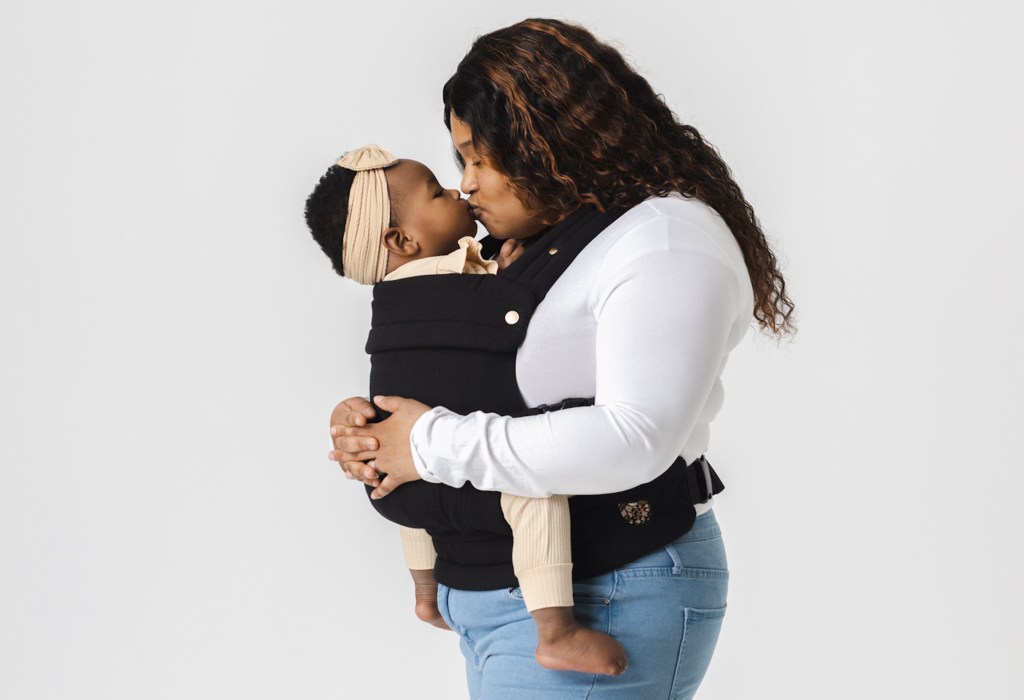
“The confidence that I had from wearing my baby on my chest was just unmatched,” she says. “However, the carrier that I had was just not the cutest thing. As a new mom, you already are not always feeling your very best. Then you layer on ugly baby gear, and it doesn’t help you feel better about yourself.”
Creating the product
The Taylors believed in the product — enough so that they invested hundreds of thousands in personal savings to bootstrap the brand.
To start, they identified manufacturers already experienced in making baby carriers. From there, they went through a months-long sampling process, testing fabrics, adjusting design details and rejecting early versions.
“The first one we got was terrible,” Hunter says.
They continued working with manufacturers until they felt they had a version worth taking to market. The process moved relatively quickly: They came up with the idea in March 2023 and launched in November of that same year. The brand’s signature Monarch Carrier is designed to look more like a stylish accessory than utilitarian baby gear and is priced at around $129.
Talking to the mom
The product was central, but Mabē’s growth strategy also depended heavily on Allie’s ability to create a brand voice that stood apart from traditional baby-product marketing. She focused on a customer’s identity and aspirations.
“I acted like a big brand from the very beginning, even though it was just me behind my phone doing all of the posting,” she says.
In the early days, she tapped people in her hometown and small-business circle for help. A friend helped build the website. Another took the brand’s initial photography. She also built an Instagram account and an email list before launch.
Its marketing message was crafted to speak to mothers as individuals rather than as extensions of their babies. Allie says she regularly asks if a piece of content will resonate, help a customer see herself in it and make her feel something.
“Instead of saying something along the lines of, ‘Our carrier has three carry positions and is safety certified, and this is the fabric and this is all the different features of it,’” she says, “I’m talking to the mom and saying, ‘Look what you can do when you put this carrier on.’”
That could mean a stay-at-home parent moving more easily through the day or an entrepreneur building a side hustle with a baby on her chest. The product benefits still matter, but Allie sees them as secondary to the messaging.
“It’s like selling them who they can become and what’s possible if they believe in themselves and if they feel confident,” she says.
The messaging gained momentum. At the time of the interview, Mabē had 176,000 Instagram followers. The founders say social media and word-of-mouth drove initial demand.
Selling out in a minute
Today, Mabē has grown into an eight-figure business in under three years, and its products recently landed at 1,700 Target stores. In 2026, the company is on pace to grow its revenue by more than 40% year-over-year.
Mabē’s early rise with customers was also unusually fast. The founders disclosed that their first launch sold out within two hours. Later, shoppers kept asking for preorders, so they decided to test it for their third launch.
Hunter remembers thousands of people waiting on Mabē’s website before the preorder began.
“Once we opened the preorder, orders started to roll in, and we sold out,” he says.
The result was startling: Mabē sold thousands of carriers in under one minute, generating about $500,000 in revenue.
“We took all of that and put it back into production,” Hunter says. “That solved a lot of our cash flow problems without having to take outside funding.”
They chose to maintain quality — even at a loss
Fast growth also tested the company’s commitment to quality. During Mabē’s first Black Friday sale in 2024, the founders discovered that a batch of fabric did not have the texture and feel they wanted. The issue was not a safety concern, they say, but it fell short of the brand’s quality standards.
The company could have waited for customers to complain and replaced only the units connected to those complaints. Instead, it contacted affected customers proactively and sent replacement carriers to everyone at no cost.
The company replaced a few thousand products, a decision the founders estimate cost around $250,000.
For a young company coming off its biggest sales period, it was a difficult financial and logistical decision. But the Taylors viewed it as an investment in a long-term brand relationship rather than a short-term expense.
“The customer first,” Allie says. “It was always about the customer; it’s always about their satisfaction and making sure that we gave them the experience that they deserve.”
Hunter added that he never intended Mabē to be “a short-term sort of cash grab.”
“We want to build a dedicated business to make people feel empowered with the product and the brand that we’re building,” he says.
Key Takeaways
Allie and Hunter Taylor launched baby carrier brand Mabē in November 2023.
The husband-wife founders funded their first product order with their own savings rather than raising outside capital.
Mabē framed its product around helping parents feel confident, hands-free and able to keep pursuing their routines and ambitions.
For Hunter Taylor, the story of Mabē goes back “to the very beginning of time.” In other words, it starts in fourth grade when he met Allie Taylor for the first time.
“I was always in love with Allie,” he tells Entrepreneur. “I just knew that she was my soulmate, that we could do anything together that we put our minds to — I felt like we could tackle the world together.”
The childhood sweethearts got married and, in 2022, became first-time parents. They quickly found a glaring gap in the market for baby carriers.
Source link
